
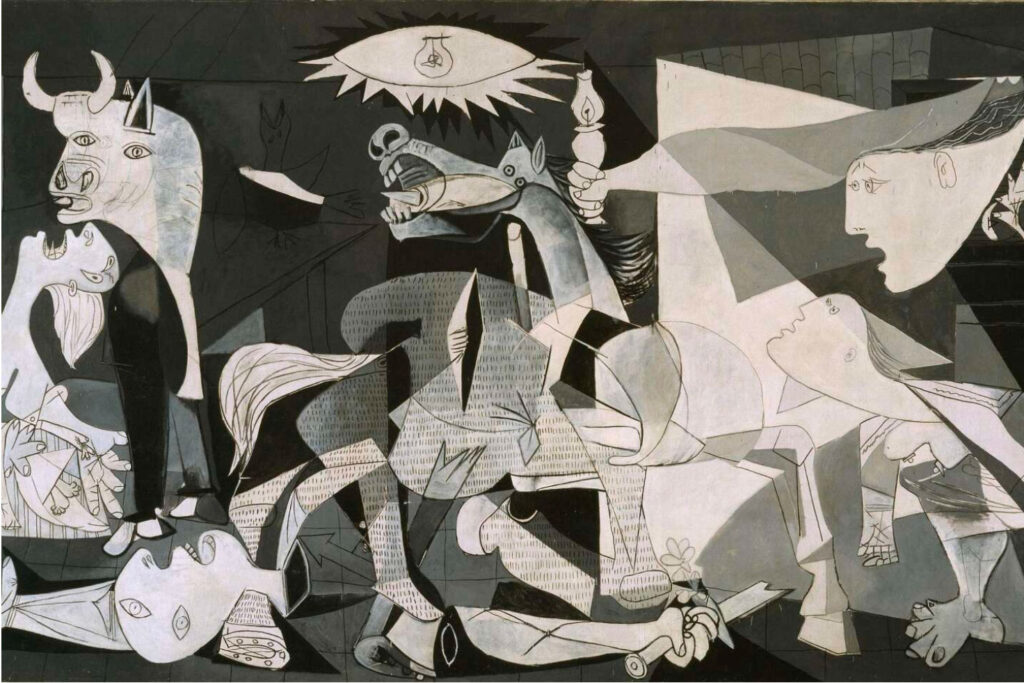
“Guernica” is one of Pablo Picasso’s most famous and influential works, created in response to the bombing of the Basque town of Guernica during the Spanish Civil War in 1937. The painting is a powerful depiction of the horrors of war, featuring distorted figures and chaotic imagery that convey the suffering and devastation inflicted upon innocent civilians.
In terms of art history, “Guernica” is significant for its innovative use of cubist techniques and its monumental scale, measuring over 3.5 meters tall and 7.8 meters wide. Picasso’s fragmented and abstracted forms, along with his monochromatic palette of black, white, and gray, create a sense of disorientation and anguish that reflects the chaos and confusion of war.
Politically, “Guernica” serves as a condemnation of violence and oppression, particularly the brutality of war and the indiscriminate targeting of civilians. The painting was intended to raise awareness of the atrocities committed during the Spanish Civil War and to advocate for peace and justice. It became a symbol of resistance against fascism and totalitarianism, inspiring countless activists and artists to stand up against oppression and injustice.
In terms of society, “Guernica” sparked widespread debate and controversy when it was first unveiled at the 1937 World’s Fair in Paris. Some critics praised the painting for its boldness and emotional impact, while others criticized it for its abstraction and perceived lack of realism. Nevertheless, “Guernica” captured the public’s imagination and became an enduring symbol of the human cost of war.